



2010 - present
2010 - present
aJourneyOf20Years
Introduction
The Malaysian Court of Appeal’s twenty years holds up a nearly perfect picture of its journey. Just to set the scene, and reflecting back 20 years, let’s start by speaking briefly about the establishment of the Court of Appeal.
The Malaysian Court of Appeal was established in 1994. It is a creature of statute introduced by way of an amendment to the Federal Constitution through the Constitutional (Amendment) Act 1994 which came into force on 24th June 1994. The Court of Appeal was intended to be an intermediary court between the High Court and the Federal Court, thus giving the litigants another avenue to appeal. It filters appeals from the High Court before reaching the Federal Court. The Court of Appeal exercises purely appellate jurisdiction. It hears civil and criminal appeals from the decisions of the High Court in the exercise of its appellate jurisdiction.
Judges
The Court of Appeal is headed by the President of the Court of Appeal [1]. In order of seniority, the President of the Court of Appeal stands immediately below the Chief Justice. The Federal Constitution provides that the President of the Court of Appeal and the Court of Appeal judges shall be appointed by the Yang di-Pertuan Agong, acting on the advice of the Prime Minister, after consultation with the Conference of Rulers [2]. The President of the Court of Appeal is also a member of the Federal Court. As a matter of practice, the President of the Court of Appeal sits most of the time in the Federal Court.
When the Court of Appeal was established in 1994, there were only eight (8) judges although ten (10) were provided for by the Federal Constitution. The pioneer judges then were Justice Zakaria Mohd Yatim, Justice Shaik Daud Haji Md Ismail, Justice Gopal Sri Ram, Justice Chan Nyarn Hoi, Justice Siti Norma Yaakob, Justice Mahadev Shankar, Justice VC George, and Justice Haji Abu Mansor Ali. The number of judges was then increased to fifteen (15) in 2001 and further increased to twenty-two (22) in 2006. In the year 2009, the number of judges was further increased to thirtytwo (32). Presently there are twenty-eight (28) judges in the Court of Appeal.
History will reflect that most of the Court of Appeal judges were appointed from amongst the senior High Court judges of Malaya or Sabah and Sarawak. However, two judges were appointed directly to the Court of Appeal. They were Justice Gopal Sri Ram who was
then a practising advocate and solicitor in the High Court of Malaya and recently Justice Idrus Harun who was formerly the Solicitor General of Malaysia.
Structure and Legal Framework
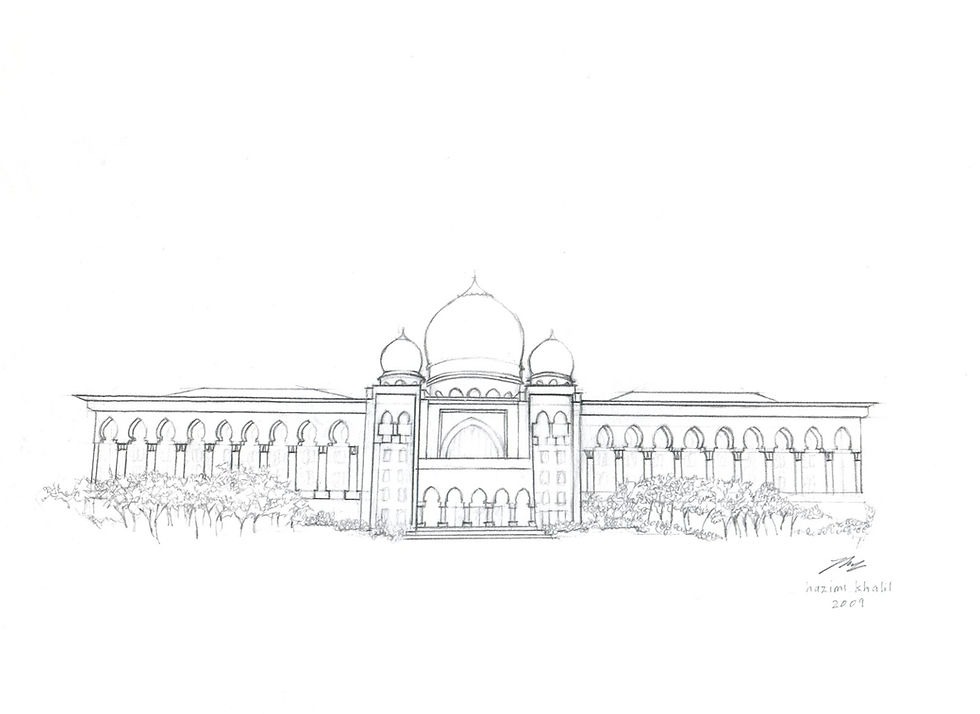
The set-up for the Registry of the Court of Appeal is provided for under Article 121(1B) of the Federal Constitution. Article 121(1B) of the Federal Constitution provides that there shall be a court which shall be known as the Court of Appeal and shall have its principal registry at such place as the Yang di-Pertuan Agong may determine. The current principal registry of the Court of Appeal as determined by the Yang di-Pertuan Agong is located at the Palace of Justice in Putrajaya. When the Court of Appeal was first established, the principal registry was housed in the historical Sultan Abdul Samad Building in Kuala Lumpur. The principal registry moved to the Palace of Justice
in the year 2000. The principal registry is headed by a Registrar who is assisted by a team of Deputy and Senior Assistant Registrars who are supported by the staff of the registry.
Presently, the proceedings of the Court of Appeal are normally held at the Palace of Justice in Putrajaya. Nevertheless, if deemed expedient, the President of the Court of Appeal may also direct its proceedings to be held at any place in Malaysia. As a matter
of practice, the Court of Appeal sits in Sabah and Sarawak in alternate months. The Court of Appeal sits in a panel of three, and occasionally in a panel of five as the President may in any particular case determine. A High Court judge may be co-opted to sit as a judge of the Court of Appeal, as has been done on several occasions before. This is permitted under Article 122(A) (2) of the Federal Constitution. Under that provision, the President of the Court of Appeal may appoint a judge of the High Court of Malaya or the High Court of Sabah and Sarawak (after consultation with the Chief Judge of Malaya or the Chief Judge of Sabah and Sarawak, as the case may be) to sit in the Court of Appeal.
The workings and legal framework of the Court of Appeal are governed by the Federal Constitution, the Courts of Judicature Act 1964 (CJA) and the Rules of the Court of Appeal 1994. As stated earlier, the Court of Appeal exercises purely appellate jurisdiction. It hears civil and criminal appeals from the decisions made by the High Court of Malaya and the High Court of Sabah and Sarawak. The Court of Appeal also functions as the final appeal court for matters which originated from the Subordinate Courts.
Jurisdiction of the Court of Appeal
i. Criminal Jurisdiction of the Court of Appeal
Section 50 of the Courts of Judicature Act 1964 (CJA) confers the Court of Appeal with criminal jurisdiction
as follows—
“(1) Subject to any rules regulating the proceedings of the Court of Appeal in respect of criminal appeals, the Court
of Appeal shall have jurisdiction to hear and determine any appeal against any decision made by the High Court-
(a) in the exercise of its original jurisdiction; and
(b) in the exercise of its appellate or revisionary jurisdiction in respect of any criminal matter decided by the Sessions Courts.
(2) An appeal shall lie to the Court of Appeal, with the leave of the Court of Appeal, against any decision of the High Court in the exercise of its appellate or revisionary jurisdiction in respect of any criminal matter decided by a Magistrates’ Court but such appeal shall be confined to only question of law which have arisen in the course of the appeal or revision and the determination of which by the High Court has affected the event of the appeal or revision.”
Thus, in criminal matters when the Court of Appeal is hearing an appeal from the decision of the High Court in the exercise of its original jurisdiction, the decision of the Court of Appeal is appealable to the Federal Court. However, if the Court of Appeal is hearing an appeal from the decision of the High Court in the exercise of its appellate jurisdiction in any criminal matter decided by the Sessions Court or the Magistrate’s Court after obtaining the leave of the Court of Appeal, the Court of Appeal stands as the final court or the apex court [3].
ii. Civil Jurisdiction of the Court of Appeal
Section 67 of the CJA confers the Court of Appeal with civil jurisdiction as follows–
“(1) The Court of Appeal shall have jurisdiction to hear and determine appeals from any judgment or order of any High Court in any civil cause or matter, whether made in the exercise of its original or of its appellate jurisdiction, subject nevertheless to this or to any other written law regulating the terms and conditions upon which such appeals shall be brought.”
Notwithstanding the above, there are matters, which are non-appealable to the Court of Appeal except with leave. This is clearly provided for under section 68 of the CJA. Section 68 of the CJA reads as follows:
“(1) No appeal shall be brought to the Court of Appeal in any of the following cases:
(a) when the amount or value of the subject-matter of the claim (exclusive of interest) is less than (two hundred and fifty)
thousand ringgit, except with the leave of the Court of Appeal;
(b) where the judgment or order is made by consent of parties;
(c) where the judgment or order relates to costs only, which by law are left to the discretion of the Court, except with the
leave of the Court of appeal; and
(d) where, by any written law for the time being in force, the judgment or order of the High Court is expressly declared to be
final.”
The circumstances in which leave to appeal will be granted would include cases where the applicant is able to demonstrate a prima facie case of error, or if the question is one of general principle decided for the first time, or a question of importance upon which further argument and a decision of the court would be to the public advantage. The order of the Court of Appeal in granting or refusing leave to appeal is final and not appealable. Civil appeals that require leave to appeal before the Court of Appeal are mostly appeals that originate from the Sessions Court or the Magistrate’s Court. For these appeals, when leave is granted, the Court of Appeal will be the final court. There will be no further appeal to the Federal Court. Decisions of the Court of Appeal in civil appeals from decisions of the High Courts in their original jurisdiction are appealable to the Federal Court only with leave unless it is provided otherwise [4].
Performance
The performance of the Court of Appeal for the last 20 years can be best shown in the two graphs on the above. The first graph is the statistics for the first ten (10) years from 1994 – 2004, while the second graph is for the years 2005 – 2014.
The number of appeals continued to swell from 2005 onwards till 2010, when the number of pending cases stood at 10,771. Even though from 2008 onwards there was a marked increase in the number of cases disposed of, but it was not able to match the number of cases registered. As can be seen from the graphs there was a surge in the number of cases registered in 2009 (6,110) as compared to those registered in 2008 (3,012). The number increased to 6,415 cases in 2010. The increase in the number of appeals registered in the Court of Appeal was a foreseeable and direct result of the reform undertaken by the Judiciary in the courts below during the tenure of Tun Zaki Tun Azmi as the Chief Justice. The reform was aimed at reducing the backlog of cases.
The problem of the high number of pending cases was further compounded by the fact that out of the 10,771 cases pending at the end of 2010, many were cases which had been pending for four to five years. There were also a number of cases that had been waiting between 6 to 10 years to be heard by the Court of Appeal.
In January 2011, new measures and initiatives were taken by the then President of the Court of Appeal, Justice Alauddin Bin Mohd Sheriff to address the problem. The judges of the Court of Appeal were asked to have more sitting days in a month. The sitting days were doubled from an average of eight days a month to 16 days a month. There was proper case management of cases. Priority was given to old cases.
Justice Alauddin Mohd Sheriff opted for early retirement in August 2011. Justice Raus Shariff was then appointed the 8th President of the Court of Appeal.
Justice Raus Sharif continued the initiative to reduce the backlog of cases began during Justice Alauddin’s tenure as the President of the Court of Appeal. Thus, by end of 2011 for the first time in the history of the Court of Appeal, the Court of Appeal was able to dispose of more cases than the number of cases registered. In that year, the number of cases registered was 5595 whilst the number of cases disposed of was 8064, thus bringing down the total number of pending cases to 8,302.
The initiatives and measures undertaken in 2011 were pursued with more vigour in 2012 and 2013. As a result, in 2012 the number of pending cases was further reduced. There were 5,086 cases registered in that year as compared to 7,835 cases disposed of. The number of pending cases was thus reduced to 5,553.
As for 2013, the number of cases disposed of was again higher than the number of cases registered, thus reducing the pending cases to 4,221. There is no doubt that the Court of Appeal judges during the period of 2011 to 2013 had worked tirelessly in reducing the backlog of cases. Some of these judges have been promoted to the Federal Court, some have retired, and some are still in the Court of Appeal. The judges who had served during this critical period deserve accolades for their support and commitment in clearing the backlog of cases in the Court of Appeal.
The sitting arrangement for the judges in the Court of Appeal was revised in 2014, given that by the beginning of 2014 the number of pending cases had come down to a reasonable level. The number of sitting days are now between 10 to 14 days in a month. This is to allow the judges to take a breather from hearing cases, and, at the same time give them more time to write their grounds of judgment. Despite the reduction in the number of sitting days, the rate of disposal is still higher than the rate of registration and thus reducing further the number of pending cases. As at 30th September 2014, the number of pending cases in the Court of Appeal stood at 3,396. Clearly great progress has been made in our backlog reduction programme. The target of having only current cases in the Court of Appeal looks set to be achieved by the end of this year.
In fact, all leave applications in civil and criminal cases are now already current, as they are being heard within the target period of three months from the date of registration. Appeals which originate from the Subordinate Courts, be it criminal or civil, will be current by end of this year. This means that in 2015, we will have only 2014 cases.
Appeals from the New Commercial Court (NCC), New Civil Courts (NCvC) and Muamalat, Admiralty, Intellectual Property (IP) and Construction Courts have a target disposal deadline of 6 months from the date of registration. Most of these cases have been disposed of within the time frame. Some did take longer than 6 months, but did not exceed a year. For example, for NCC cases, out of 360 cases registered in 2013, 342 had been disposed of, leaving a balance of 18 cases which should be disposed of by the end of the year. Similarly, for NCvC cases, out of 1,354 cases registered in 2013, 1,315 had been disposed of leaving a balance of 39 cases which are targeted to be disposed of by the end of the year. However, appeals from Muamalat, Admiralty, Intellectual Property and Construction Courts are current. For these appeals, there are only 2014 appeals pending.
Admittedly, we are still struggling to dispose of death penalty appeals. For 2014, our target is to reduce the waiting period of these cases to not more than 18 months. For the record, as at 30th September 2014, we still have 129 pre-2014 appeals pending. We are hoping to reduce the waiting period to one year by the end of 2015. If we are successful in this, then come 2016, the waiting period for all cases in the Court of Appeal will not exceed one year.
Nearly four years ago, as at 31st December 2010, there were 10,771 appeals pending in the Court of Appeal. Between then and 30th September 2014, there were 18,398 appeals registered in the Court of Appeal. By that date of 30th September 2014 the number of pending appeals was 3,396. The Court of Appeal had successfully disposed of 25,672 appeals within the period of 45 months.
Armed with the confidence gained from the strides we have made in the past twenty years, the Court of Appeal renews its unwavering commitment to the administration of justice. We will boldly and surely continue along our charted course into the future.
[1] Article 122A of the Federal Constitution
[2] Article 122B of the Federal Constitution
[3] Refer cases of Munawar Ahmad Anees v PP [2010] 1 CLJ 302 and Dato’ Ahmad Zubair v PP [Federal Court Criminal Appeal No: 05-241-
10/2013(W)]
[4] Section 96 of the Courts of Judicature Act 1964.


* CLICK FOR MORE IMAGES *